

Getting Go-to-Market Right in the First 90 Days
When a company changes ownership, its business strategy shifts. Since a new strategy requires leadership capable of executing it, the executive team often turns over, and the first change is usually the CEO.
What happens next is a highly focused race. The board expects a refined strategy and full plan in at most 90 days. Not a direction, and not a set of priorities. A plan with data behind it, a companion organizational structure, the metrics that will govern performance, and a budget and resourcing model that the board can approve and then hold the CEO and leadership team accountable to.
All of this happens while the current version of the business keeps running. The market doesn’t pause for the transition. Often, this work surfaces friction points in the company's go-to-market (GTM), such as acquisitions integrated on paper but not in practice; lingering product issues or tech debt that is known but has no prioritization or plan. During all of this, the team is absorbing significant change in real time, which means every week of visible uncertainty costs focus and talent retention. Customers also have questions about the company's future and often use the leadership shifts as negotiating leverage because they worry the company will be too internally distracted to maintain quality customer engagements.
Key roles, such as the Chief Marketing Officer (CMO) and Chief Revenue Officer (CRO), face intense, immediate scrutiny. CMOs are often viewed as expendable, and replacing one is a quick way to free up cash. A CRO who misses the number typically gets about thirty days while the new owners establish what is actually happening, and then is let go. A CRO who hits the number gets scrutinized instead, because performance under the previous strategy proves very little about performance under the new one.
Which leaves the accountability for growth and sustainable revenue streams where it belongs and where it stays regardless of who else is on the leadership team. The CEO may get help from current or new leaders, consultants, or operating partners, but make no mistake: the CEO owns it without excuses.

The Two Traps
With one foot in the current state and one foot building the future, the leadership team often falls into two traps. Both begin as reasonable instincts. Both happen in the first few weeks. Together they consume the quarter and create risk in the 90-day outcome.
The first trap belongs to the CMO, and it involves branding. Either the CMO is asked to begin a rebrand in parallel with the strategy work, because new owners want the market to see that something has changed, or a new CMO arrives and assumes a full rebrand is required, which also buys the new CMO time to learn the business.
The problem here is the catalyst and the sequencing. A rebrand by request or to buy time can't go deep enough without the new strategy. Sometimes the argument is made that the brand is higher-level and these details are handled in deeper underlying messaging. Fair point, but it can fracture a new brand and waste time and money to fix those fractures later. Brand work can move very fast or painfully slowly. Force-fitting brand completion into a time window that doesn't include a finished strategy is a recipe for a mismatch your customers and employees will notice.
The mismatch usually shows up as a point of view that is indistinguishable from the product. The company can describe what it sells but not why it matters in the current market. A visual design system can’t fix that, because a point of view is a claim about the market, and the design should follow from it. Claim clarity as your position, then build an identity in muted greys with soft fades, and nothing in the design supports the claim.
You can't define the company's point of view until you know where it can actually grow, which, according to GTM Partners, is almost always the systemic root cause of growth problems.
The second trap belongs to the CEO, who goes deep into sales right away out of necessity. Revenue generation must continue while the new strategy takes shape, so you have to find and protect what's working, at least for the next two quarters. At the same time, anything causing known friction today that looks likely to persist under any future strategy must be dealt with quickly. Most CEOs are deeply involved in this work.
The limitation is what the triage can and can't see, and most CEOs are well aware of it. Sorting sales into what works and what doesn't can only be done against the current strategy, which will evolve or be replaced. What is less visible in the data but often captured by assumptions is what produces results today that won't under the new strategy based on what is being built in real time. This can lead to a lot of repeat analysis as the new strategy comes together because no one has fully answered where the company can and should grow and which products create the highest customer value. This creates distraction, confusion, and burnout in the team.
Meanwhile, preserving revenue usually means leaning harder on individual performers. That's fine short term. But if the company falls into the trap of relying on heroic sales players rather than defined sales plays, the new strategy is harder to operationalize.
Put together, the company has a finished brand identity attached to an undifferentiated point of view, and a revenue engine reinforced around what worked in the past. All this background work can look like progress on a board slide at day 45, but left unchecked, it results in minimal to no progress at day 90.
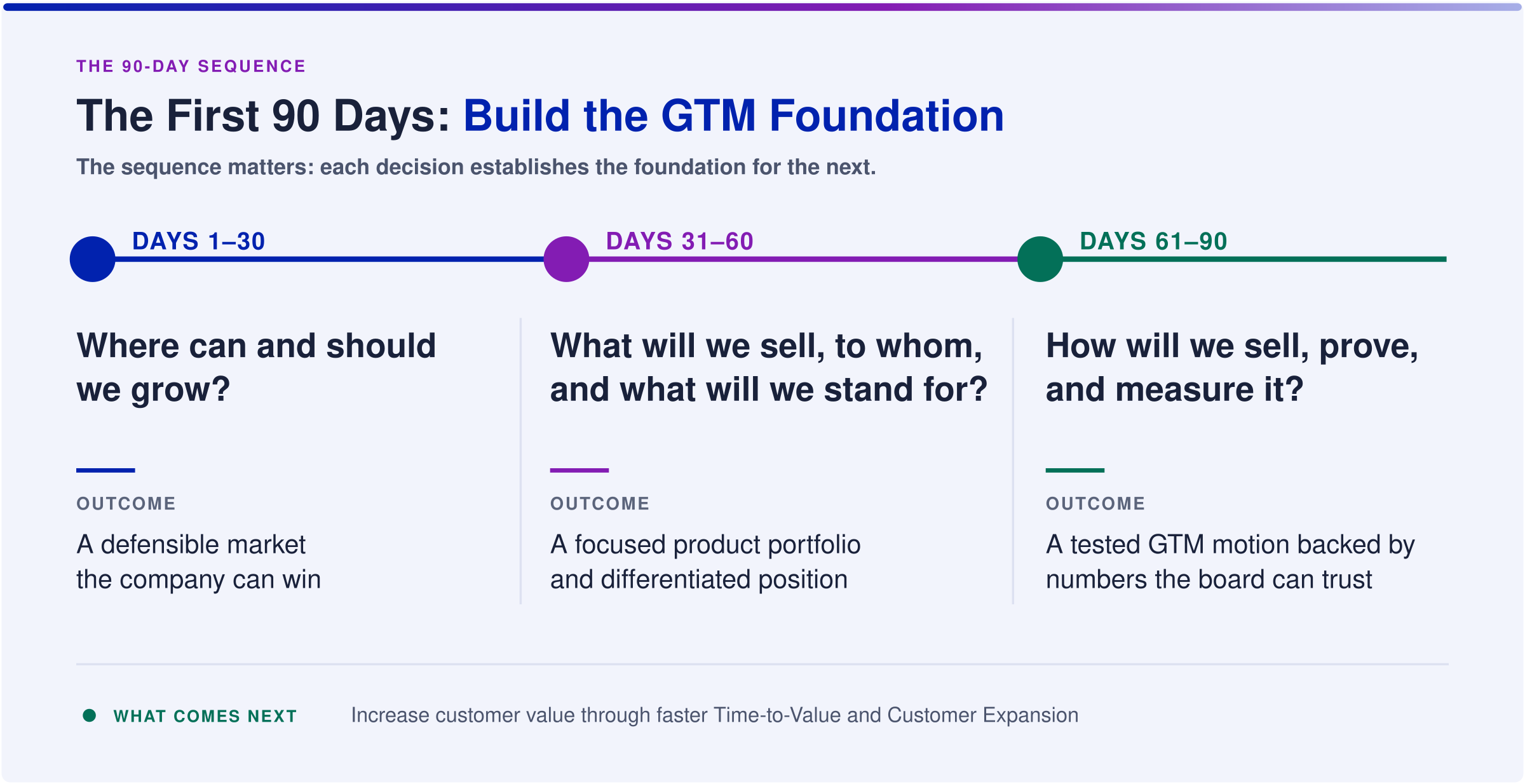
Days 1 to 30: Establish Where the Company Can Actually Grow
Most companies believe they know their market. What they usually have is a market definition inherited from a prior strategy, built on industry codes and company size, and that is very out of date.
The new owners’ acquisition thesis contains a market assumption and was written by people working from the outside, under deal timelines, using diligence data. That market assumption is now the cornerstone of the company's operating plan, whether or not it holds up under contact with the customer base.
Ensuring you deeply understand the market often gets skipped when the company acquires a competitor in the same space. Everyone already knows the space. But two overlapping customer bases do not produce one combined market. Some of the overlap is real duplication. Some segments were served well by one company and poorly by the other, and the combined entity now has to decide which standard applies. Some accounts were won precisely because the two companies competed, and that reason no longer exists. None of this appears until someone does the math, and the math rarely produces the sum the deal model assumed.
Theory and reality are different words for a reason.
The work in the first thirty days is to clarify that reality by answering one question. Where can and should this company grow the most? This is the Total Relevant Market. That means segmenting the existing base by the value actually delivered, rather than by industry code or employee count, and then looking at where customers can quantify what they got. It means sizing what is genuinely winnable with these products, this team, and this capital, rather than sizing a category. And it means being willing to report a smaller number than the thesis deck contained. It also means telling the board which parts of the number you can defend and which parts are still an estimate. No board expects complete certainty in month one. They do expect you to know the difference.
Doing this surfaces a problem immediately. The data you need to answer the question is the data the prior strategy produced. Lifecycle stages were defined for a different motion. Accounts were coded to the market definition you are replacing. Customer value was recorded, if it was recorded at all, against products you may be about to wind down. You will not fix all of that in thirty days, and you should not try.
Narrow it instead. Reconstruct only what the growth question requires, manually if that is what it takes, and note every gap and workaround you hit on the way. That list becomes part of the specification for the Revenue Operations work in month three. The market analysis and the data foundation then get built once rather than twice.
A defensible market where the company wins is worth considerably more than a large one where it competes without advantage. Delivering that finding to the board in month one is a credibility move, not a risk, because the alternative is defending the original number for three more quarters and then explaining the miss.
Running in parallel, and taking far less time than it appears to, is the leadership work. That means creating clarity, alignment, and a team mentality. What the company is doing and why, how it will be done, and who is accountable. The organization is watching to see whether the new CEO has this view, and that window closes quickly. A team that goes sixty days without hearing the reasoning will construct its own, and the versions people invent are almost always worse than the truth.
Days 31 to 60: Decide What You Sell, to Whom, and What You Stand For
The market work tells you where to grow. The next question is what to sell there. Companies dodge it, because answering it means telling someone their product is not the priority.
This is the Market Investment Map. It scores your products by the value they create for each segment, then sorts them by what you fund and what you wind down. This makes it clear where you'll add new customers and where you’ll focus on expanding within current customer accounts. Then you create the correct pricing and packaging to support these decisions.
This is where many companies stall. They don't want to make the tradeoffs. A product stays in the mix long past the point it should, because it had a big customer or a committed roadmap that no one wanted to rework. An acquisition makes it worse. Two companies that each had a flagship product, and they brought them into the newly combined company. If you sell both equally, you confuse your existing customers and the market. That makes everything your sales team does harder, and it makes it impossible for your marketing team to brand.
The Market Investment Map gives your brand an anchor and a path to evolve. This is where the brand identity effort belongs, built on decisions instead of hypotheses. Your point of view is now clear because you know where you will win and which products you'll lead with. You can now build your brand to serve your focused strategy and start building trust with customers.
Clarity is a momentum builder.
Days 61 to 90: Prove the Motion and Give the Board Real Numbers
By now you know where and how you'll grow, and that feeds new direction into your brand's evolution. The next question is what sales motions you need to deliver that growth, and how similar or different they are from the sales motions in use today.
his is Pipeline Velocity. It covers how you structure the sales team, how you qualify and run deals, and which motions you lean on to hit the number. The earlier trap was optimizing the old motion. Now you have earned the right to rebuild it, because you finally know what it is supposed to deliver. Some of what worked before still works. Some of it is carrying you in a direction you are leaving, and this is when you stop funding it.
You won't perfect this in thirty days, and you shouldn't try. What you can do is test. Pick the one or two motions the new strategy depends on most, run them hard enough to see whether they deliver as intended, and find where a few more tweaks would make it even easier for sales to close. Set the bar for what counts as proof before you start. Enough deals to know it repeats, and review losses as closely as wins. A motion that looked right on a slide and stalls in the field is something you want to learn in month three, not month nine, while there is still time and budget to correct it.
Underneath all of this, you need numbers you can trust. This is Revenue Operations. In the first 90 days, Revenue Operations builds trust internally first, with a single set of definitions, clear taxonomies, and one vetted version of the pipeline, so everyone creates insights and makes decisions from a known-good data set. If sales, marketing, and finance each show up to the board meeting with a different number, the plan loses credibility before you say a word.

One caution. A shared definition applied to bad inputs produces agreement and nothing more. This is where the gaps you cataloged in month one pay off, because you already know which figures were reconstructed, which were assumed, and which need a real fix before anyone runs the business on them.
The single source of truth earns its keep beyond the boardroom. It lets you see whether any of the work from the first two months is actually moving the company forward. Get it right, and day 90 becomes a new strategy that delivers and is backed by data you can defend.
What Waits Until After Day 90, and Why
A serious 90-day plan is defined as much by what you leave out as what you take on. Two pillars that have sizeable impact in year one, but need to run as-is in the background the first 90 days, are Customer Time- to-Value and Customer Expansion. Background does not mean unwatched. Keep a radar up for retention risk.
Both are among the highest-return work you will do all year. Expansion is revenue growth from customers you already have. It shows up in net revenue retention (NRR), which measures that growth after netting out churn, and strong expansion is often the difference between a company that scales and one that runs harder every quarter to stand still. Time-to-Value is measured by how fast a customer reaches the first value creation milestone, and the faster they get there, the better everything downstream goes, from renewals to references.
These two pillars wait because both depend on answers you won't have yet. Typically, you'd grade expansion accounts as expandable, retainable, or at-risk. You can't grade a single account until you know which segments you are betting on and which products lead, which is the market and portfolio work of the first two months. At-risk accounts are the exception. Those accounts are at risk today, and you deal with them now. Try to run expansion before then, and you will pour effort into accounts the new strategy is about to walk away from. Time-to-Value has the same problem. You cannot shorten the path to value until you have decided what value you are actually selling, and that decision is barely dry at day 90.
The Day 90 Deliverable
Ninety days in, the board is expecting a plan that is short, specific, and defensible under questioning relative to the new owner's investment thesis. Your work in the first 90 days provides them exactly that.
Here are the pieces you now have in place:
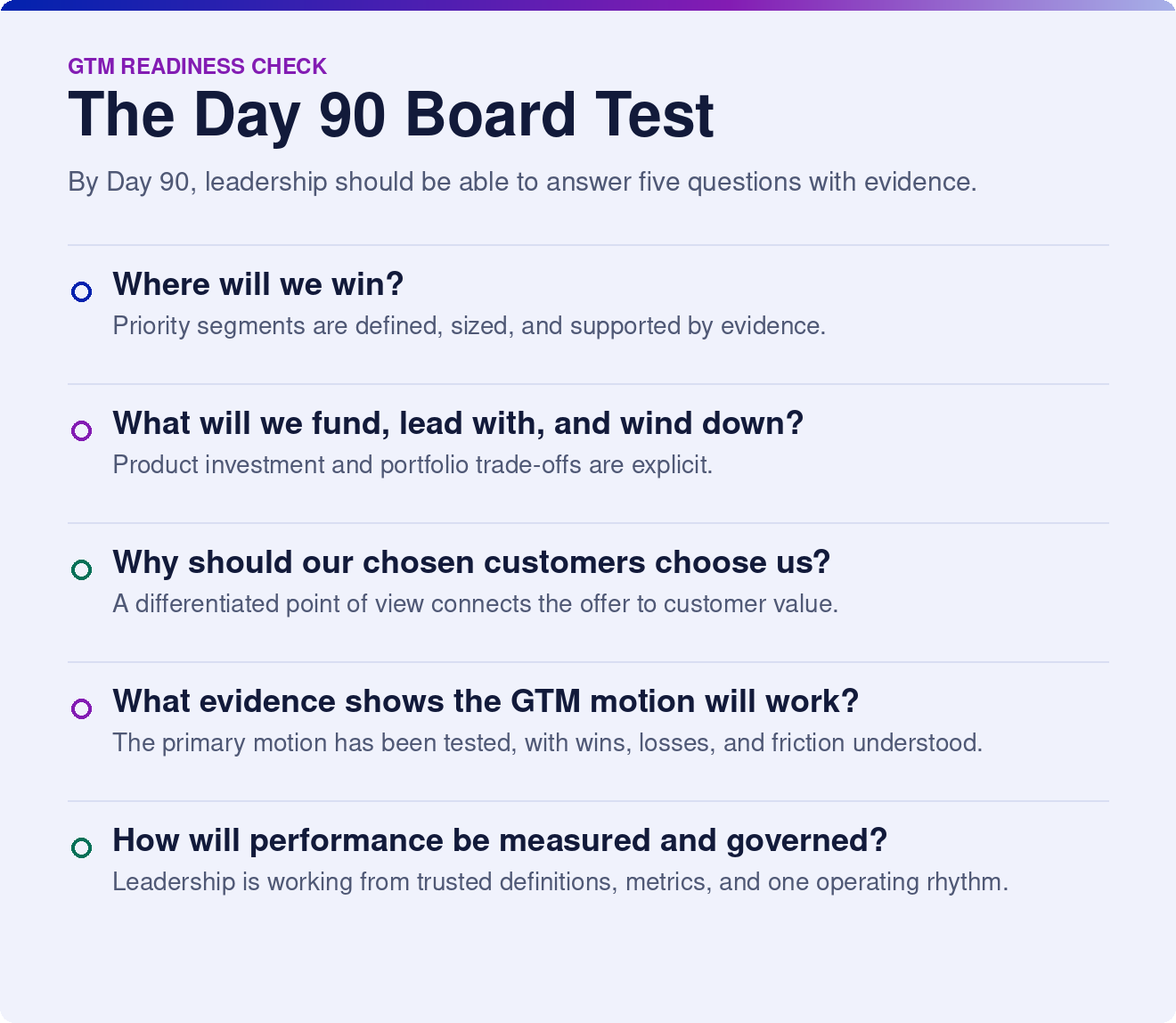
- Market definition. Where the company will win and, just as important, where it will not compete. This is the output of the first thirty days, and defines the segments, the reasoning, and the size of the opportunity in each.
- Portfolio rationalization. What the company leads with, what it funds, and what it winds down.
Anyone reading it should be able to see which products carry the strategy and why the others don't. - Differentiated point of view. Why the company matters to the customers it has chosen, expressed
clearly enough that sales and marketing can infuse it into their work. - Tested GTM motion. A primary motion with early evidence from having run it, including what works
well and what needs adjustment before it scales. - Metrics and operating rhythm. How the company will be measured and how often the leadership
team will review it, built on one source of truth everyone trusts.
Each of these fits on a page. Together they are a plan the board can trust and the team can actually run. The plan is valuable and trustworthy because every claim in it is backed by 90 days of real work rather than a set of intentions or assumptions.
The Foundation the Board Can Trust
Everything in the first 90 days comes down to one outcome. A go-to-market foundation the board can trust, and the team can run. Get that right and the rest of the year has a solid foundation for growth. Get it wrong, or skip the sequence to show early motion, and the company spends the next three quarters paying to redo it.
The order is what makes it work. Where you can grow, then what you sell and stand for, then how you sell it and measure it. Each decision rests on the one before it, and the decisions made now become the defaults the company runs on.
I've laid this work out over 90 days, which may feel ambitious or may feel slow. It's unlikely you'll get longer than 90 days, so if you can move faster, you should. This methodology also shows the board how you're working through getting the foundation right, which starts building trust while you work through the details.
A CEO and leadership team rarely have time to do this well on their own. The foundation work benefits from an objective outside partner who can move fast, has done it before, and has no stake in which product wins, whose team survives, or whose numbers turn out to be wrong. That leaves the CEO's judgment for people and priorities, which only they can do.
This is the work I do with CEOs and their investors.
How strong is your GTM foundation?
The GTM Assessment will help you see where the foundation is solid and where the foundation is solid and where it needs more work. You’ll receive a PDF report by email with insights based on your answers.